
How Do Bats Get Into Homes in Kansas?
If you are hearing movement in the attic, finding small piles of droppings near your home, or watching bats leave the same spot on your roof every evening, you may be asking one question:
How are bats getting into my house?
The answer is often less obvious than homeowners expect.
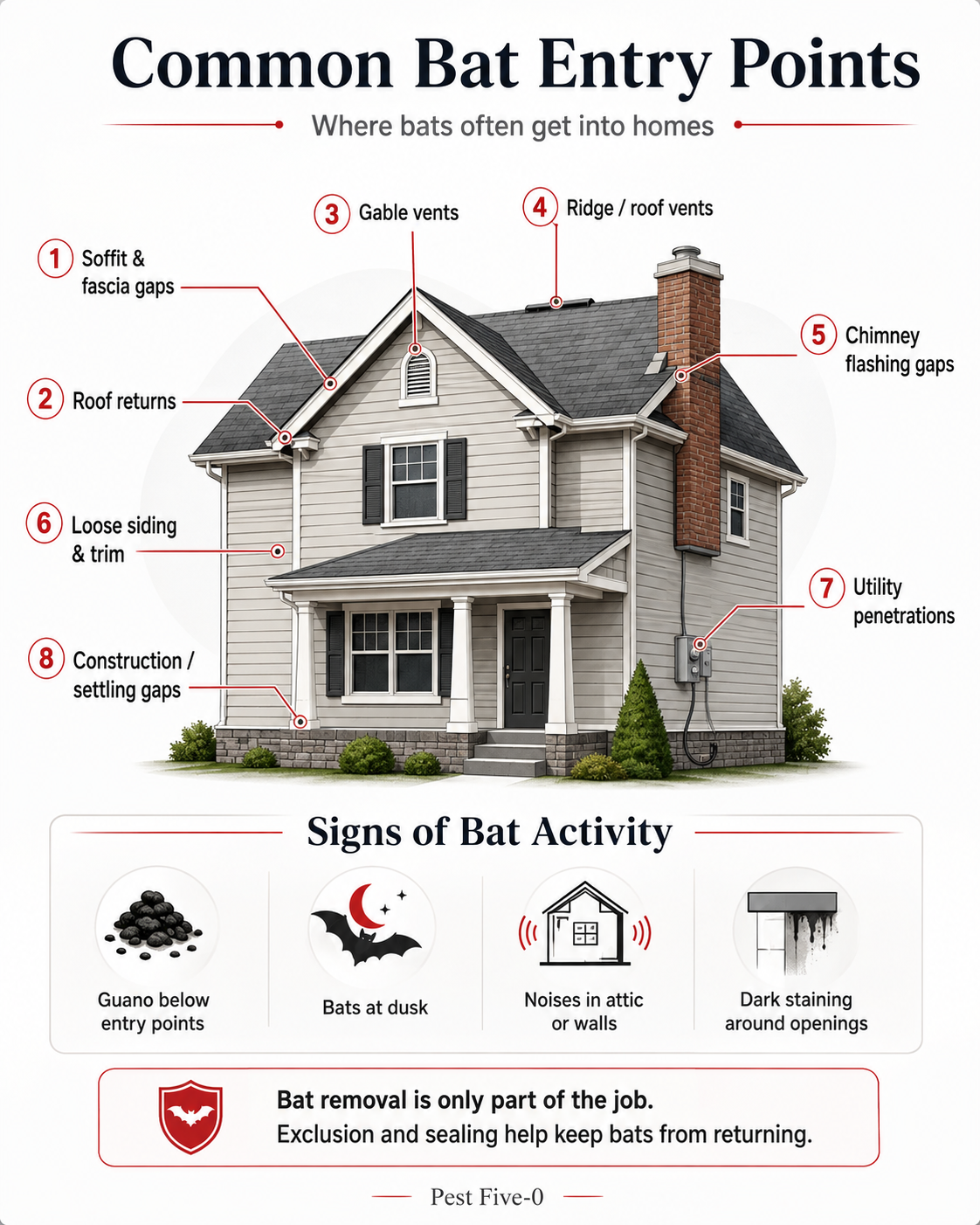
Bats can use small gaps around rooflines, soffits, fascia, vents, flashing, siding, chimneys, and other construction areas to access protected spaces inside a home.
And once bats find a suitable roosting location, simply getting one bat out does not necessarily solve the problem.
The real solution starts with understanding how bats are entering the structure in the first place.
How Do Bats Get Into Homes?
Bats generally enter homes through existing gaps or openings in the exterior of the structure.
They are not chewing holes into the building like some rodents might. Instead, they take advantage of construction gaps, loose materials, damaged areas, and openings that already exist.
“Bats have multiple ways to get into your home, not just the movie scene chimney entry”
-Connor Fairbanks
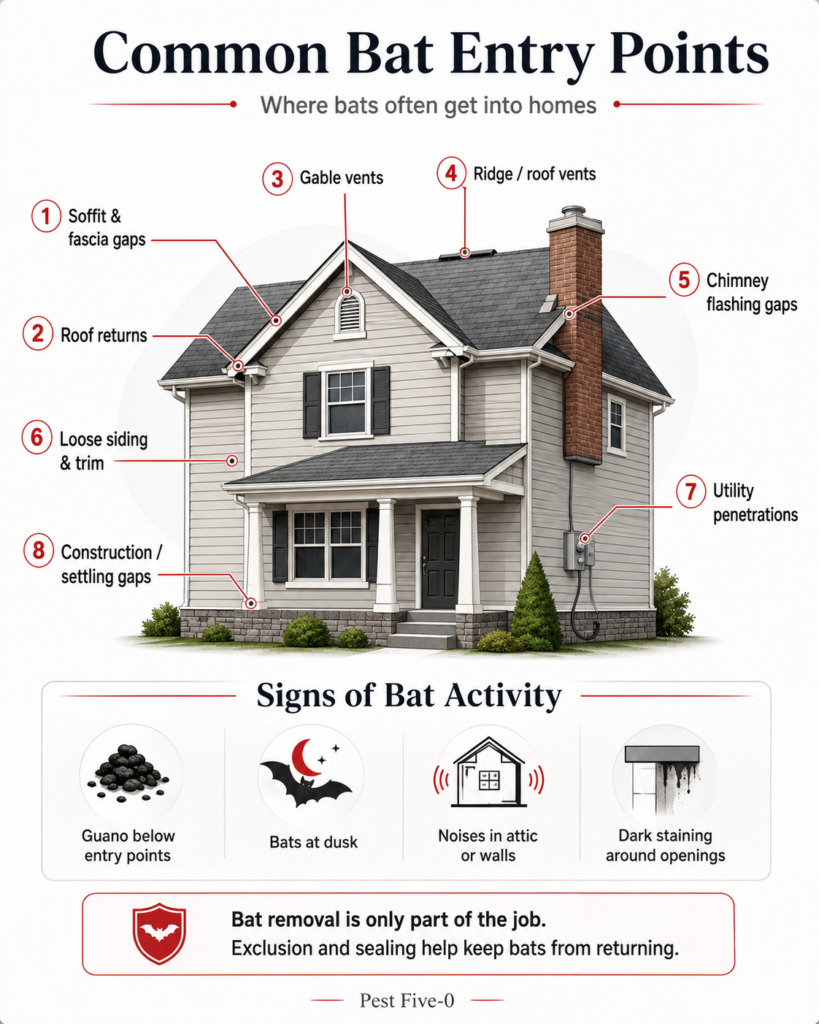
Common bat entry points include:
- Gaps around soffits and fascia
- Roofline transitions
- Gable vents
- Ridge and roof vents
- Chimney flashing
- Loose siding or trim
- Openings around utility penetrations
- Construction gaps
- Areas where building materials have shifted or separated
Many of these openings can be difficult to identify from the ground.
That is one reason a proper bat inspection involves evaluating the entire exterior of the structure, not simply looking for one obvious hole.
Why Do Bats Choose Houses?
Most bats that enter buildings are not trying to get into the rooms where people live.
They are typically looking for a protected place to roost.
Homes and other buildings can provide conditions that make certain structural areas attractive to bats, including:
- Protection from weather
- Warm attic spaces
- Dark, quiet areas
- Elevated locations
- Protection from predators
- Access to nearby feeding areas
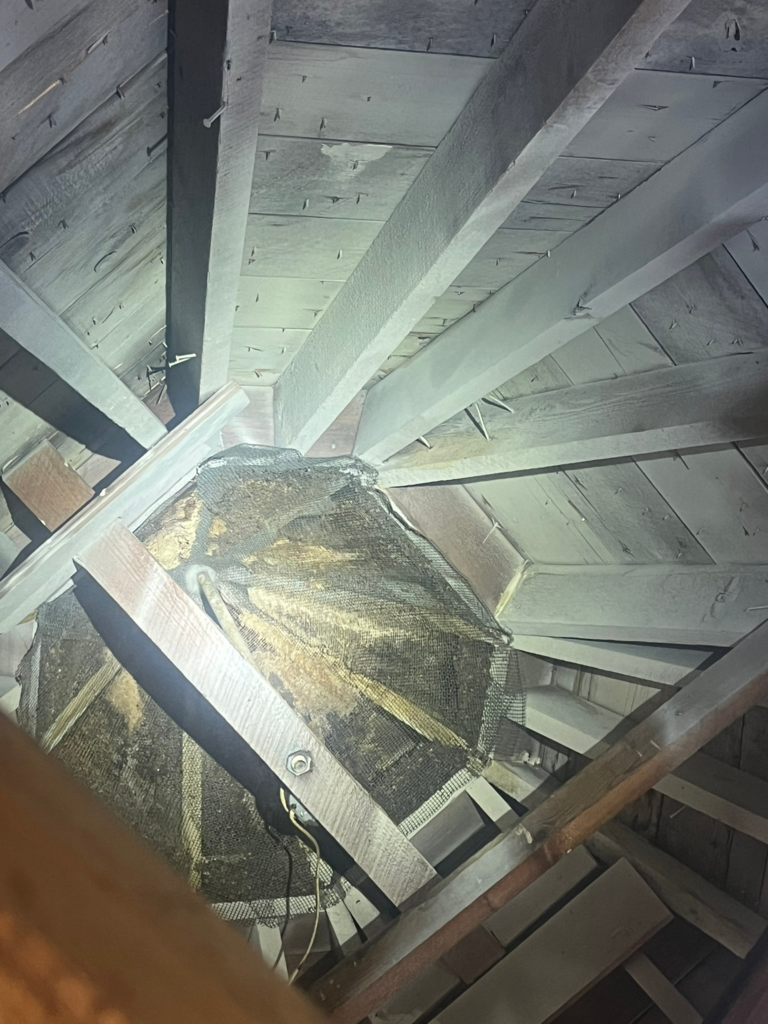
Attics, roof assemblies, wall voids, and other protected structural spaces can provide excellent roosting locations.
If an accessible opening leads into one of those spaces, bats may begin using the building.
How Small of a Hole Can a Bat Get Through?
One of the biggest mistakes homeowners make is assuming there must be a large opening somewhere on the house.
Bat entry points can be surprisingly small.
A gap that looks insignificant from the ground may provide enough room for a bat to access the structure.
This is particularly important around complicated sections of a roof.
Homes may contain dozens—or even hundreds—of joints, transitions, vents, trim pieces, and construction details where small openings can develop.
As a result, finding the primary entrance does not automatically mean you have found every possible entry point.
7 Common Places Bats Get Into Kansas Homes
Although every building is different, there are several areas we commonly evaluate when inspecting a structure for bat activity.
1. Soffit and Fascia Gaps
The soffit and fascia system runs along much of a home’s roofline.
Small gaps can develop where different materials meet or where panels, fascia, or trim have shifted over time.
These areas can provide bats with direct access into attic or roof spaces.
2. Roof Returns and Roofline Transitions
Any location where two portions of a roof come together deserves attention during a bat inspection.
Roof returns and complicated roof transitions can contain hidden gaps that are difficult to spot from below.
These areas also tend to be sheltered, making them attractive access points.
3. Gable Vents
Gable vents provide ventilation to attic spaces.
However, damaged screening, gaps around the vent, or openings within the installation may provide bats with a route directly into the attic.
A vent can look completely normal from the yard while still containing a small accessible area.
4. Ridge Vents and Other Roof Vents
Roof ventilation systems are another potential access point.
Depending on the construction and condition of the roof, bats may find openings around:
- Ridge vents
- Roof vents
- Vent edges
- Flashing
- Installation gaps
These areas are especially important when bats appear to be emerging from high along the roof.
5. Chimneys and Flashing
The area where a chimney meets the roof contains several different building materials and transitions.
Small openings around flashing, trim, or other construction joints can sometimes provide access to the structure.
6. Siding and Exterior Trim
Loose siding, separated trim, or openings behind exterior materials can lead into protected cavities.
The visible opening may be small while the area behind it is significantly larger.
7. Construction and Settling Gaps
Buildings move over time.
Heat, cold, moisture, settling, age, repairs, and original construction can all create small openings between materials.
That means bat entry points are not limited to old or poorly maintained houses.
Newer homes can have bat-accessible construction gaps as well.
What Are the Signs of Bats in a House?
You may have bat activity without ever seeing a bat inside your living room.
In fact, many homeowners first notice signs around the outside of the building.
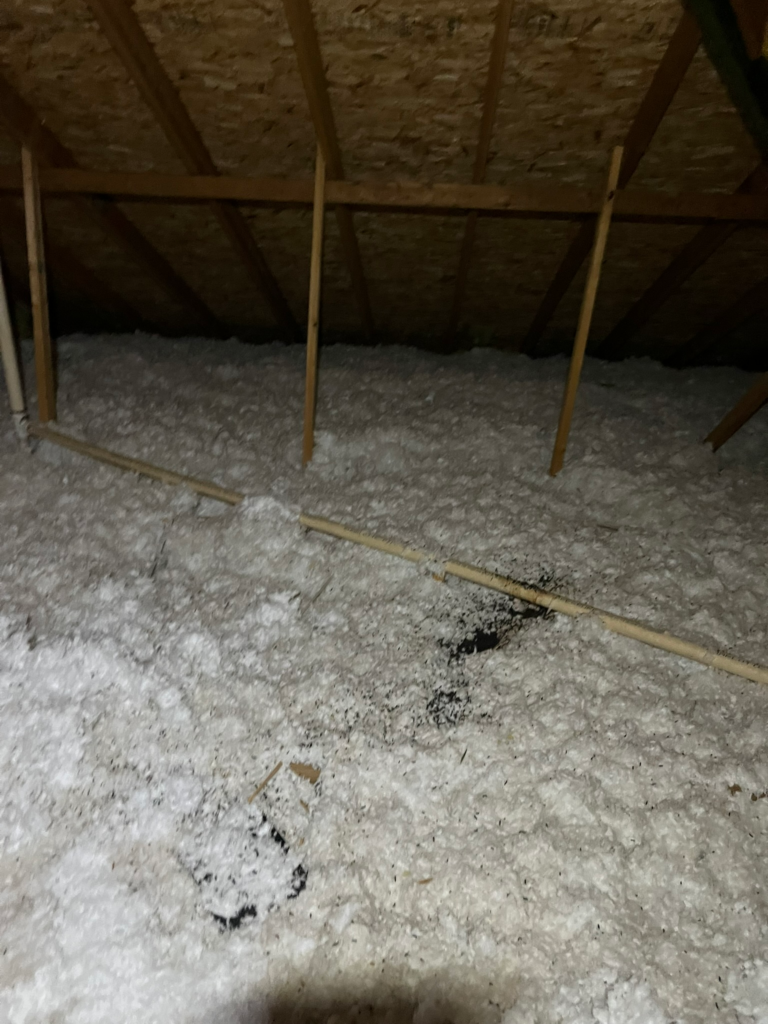
Guano
Bat droppings—often called guano—may accumulate:
- Below an entry point
- Along siding
- On a roof
- Near the foundation
- Inside an attic
- On insulation or framing
Repeated accumulation in the same area can help identify where activity is occurring.
Bats Leaving at Dusk
One of the most useful signs is repeated activity around sunset.
If bats consistently emerge from the same part of the roofline in the evening, there may be an active roost or access point in that area.
Scratching or Fluttering Sounds
Homeowners may occasionally hear light movement from:
- Attics
- Ceilings
- Walls
- Roof assemblies
The sound may be subtle and is sometimes more noticeable early in the morning or around dusk.
Staining Near an Opening
Frequently used access points can sometimes develop visible discoloration or staining around the opening.
A Bat Inside the Living Space
Finding one bat indoors does not automatically mean there is a colony in the attic.
However, repeated indoor sightings deserve further investigation.
There may be an opening that allows bats to move from an attic, wall void, chimney area, or other structural space into the living area.
What Should You Do If You See Bats Leaving Your Roof?
Watching the home around dusk can sometimes provide valuable information.
If several bats repeatedly leave from the same location, make a note of the area.
However, avoid immediately sealing the opening.
If bats are actively using the structure, closing their exit while they are still inside can create additional problems.
Instead, the next step should be determining:
- Whether bats are actively roosting inside
- Which opening is being used
- Whether additional entry points exist
- Whether the timing is appropriate for exclusion
- What areas of the structure need to be sealed
This is where bat exclusion becomes important.
What Is Bat Exclusion?
Bat exclusion is a method used to allow bats to leave a structure while preventing them from returning through the same opening.
Rather than simply trapping or removing individual animals, exclusion addresses how bats are using the building.
A professional bat-exclusion process may involve:
- Inspecting the exterior of the structure
- Identifying active bat entry points
- Identifying secondary or potential entry points
- Sealing appropriate secondary openings
- Installing one-way exclusion devices where appropriate
- Allowing bats to exit
- Monitoring or verifying activity
- Removing the exclusion device
- Permanently sealing the remaining opening
The exact process depends on the property.
A simple one-story home with one obvious entry point can be very different from a multi-story building with a complicated roofline and several potential access areas.
Why Can’t You Just Seal the Hole?
Because there may still be bats inside.
This is one of the most important things to understand about bat removal.
If an active opening is permanently sealed while bats are still using the structure, those bats may become trapped.
They may then search for another way out.
In some cases, that can mean bats entering areas of the home where people are living.
A proper exclusion strategy allows active bats to exit before the final opening is permanently sealed.
Why Bat Removal and Bat Exclusion Are Different
Getting a bat out and solving a bat problem are not always the same thing.
Consider this example:
A homeowner finds a bat flying through the living room.
The bat is removed.
Problem solved?
Not necessarily.
The more important question is:
How did that bat gain access to the building?
If the structure still contains an opening that allows bats inside, another bat may eventually appear.
That is why long-term bat control focuses heavily on structural exclusion.
Removal addresses the animal. Exclusion addresses the access.
Why the Entire House Should Be Inspected
A bat colony may primarily use one opening, but that does not mean it is the only opening available.
Imagine sealing the main gap while leaving another similar opening a few feet away.
You may simply move the activity.
During a bat inspection, other potential access points should be considered, including:
- The complete roofline
- Soffits
- Fascia
- Vents
- Siding
- Chimneys
- Roof transitions
- Flashing
- Trim
- Utility penetrations
This whole-structure approach is one of the most important parts of a professional exclusion.
Does the Time of Year Matter for Bat Removal?
Yes.
Bat exclusion can involve seasonal considerations, particularly when young bats are present and are not yet capable of leaving the roost on their own.
That means a bat problem should not always be approached by immediately sealing every opening.
The activity, structure, time of year, and condition of the roost all need to be considered before determining the appropriate exclusion strategy.
Can Bats Return to the Same House?
They can if the structure continues to provide accessible entry points.
That is another reason removing individual bats is often not enough.
If the openings remain available, bats may continue using the building in the future.
Structural sealing makes the home less accessible by addressing the areas bats are using—or could potentially use—to get inside.
Do Bats Damage Houses?
The primary concern with a bat roost is often not physical chewing damage.
Instead, problems can involve:
- Accumulated guano
- Urine
- Odor
- Contamination of attic areas
- Repeated bats entering living spaces
- Continued access through structural openings
The amount of cleanup or remediation required depends heavily on the size and duration of the activity.
How Much Does Bat Removal Cost?
There is no universal price for professional bat removal or exclusion.
The cost can vary depending on factors such as:
- Size of the home
- Number of stories
- Linear footage requiring sealing
- Roof pitch
- Roof complexity
- Accessibility
- Number of potential entry points
- Amount of exclusion work required
- Specialty equipment or lift requirements
- Travel distance
That is why an inspection is often necessary before an accurate exclusion quote can be provided.
Frequently Asked Questions About Bats in Houses
Does one bat mean there are more?
Not necessarily.
A single bat can occasionally enter a home without an established colony being present. However, repeated sightings, guano accumulation, noises, or consistent dusk activity may indicate bats are using the structure.
Where do bats usually hide inside a house?
Common areas can include attics, wall voids, roof assemblies, chimneys, and other protected structural spaces.
Will bats leave on their own?
Bats naturally leave roosting areas to feed, but that does not mean they will permanently abandon a suitable structure.
If they can continue accessing the building, the activity may continue.
Can I see a bat entry point from the ground?
Sometimes.
However, many openings are extremely difficult to identify from ground level, particularly on tall homes or complicated rooflines.
Should I seal a bat entry point myself?
An active entry point should not simply be sealed without knowing whether bats remain inside.
The timing and order of sealing are important parts of the exclusion process.
Bat Removal in Salina, Kansas
If you are finding signs of bats around your home, Pest Five-0 provides professional bat inspections, exclusion, and structural sealing in Salina and surrounding Kansas communities.
We focus on determining how bats are using the building—not simply dealing with one animal after it appears inside.
If you are in the Salina area, visit our Bat Removal in Salina, KS page to learn more about local service.
For information about the complete service and exclusion process, visit our Bat Control & Removal page.
Think Bats Are Getting Into Your House?
If you are seeing bats around the roofline, hearing activity in the attic, finding guano, or repeatedly discovering bats inside the home, an inspection can help determine what is actually happening.
The most important question is not simply:
“How do we get this bat out?”
It is:
“How are the bats getting in?”
Finding that answer is the first step toward solving the problem correctly.
Call Pest Five-0 at (785) 829-5550 to schedule an inspection.
Leave a Reply